

Abu's Ice Cream

As my parents and I waited at the airport gate, I asked them if they wanted to drink any tea. “No” they both said, but then with a smile, my father asked me for ice cream. I tried to find something in the food court in the New Delhi airport, but as our departure time approached, I told my father, I would get him some ice cream when we were back in America.
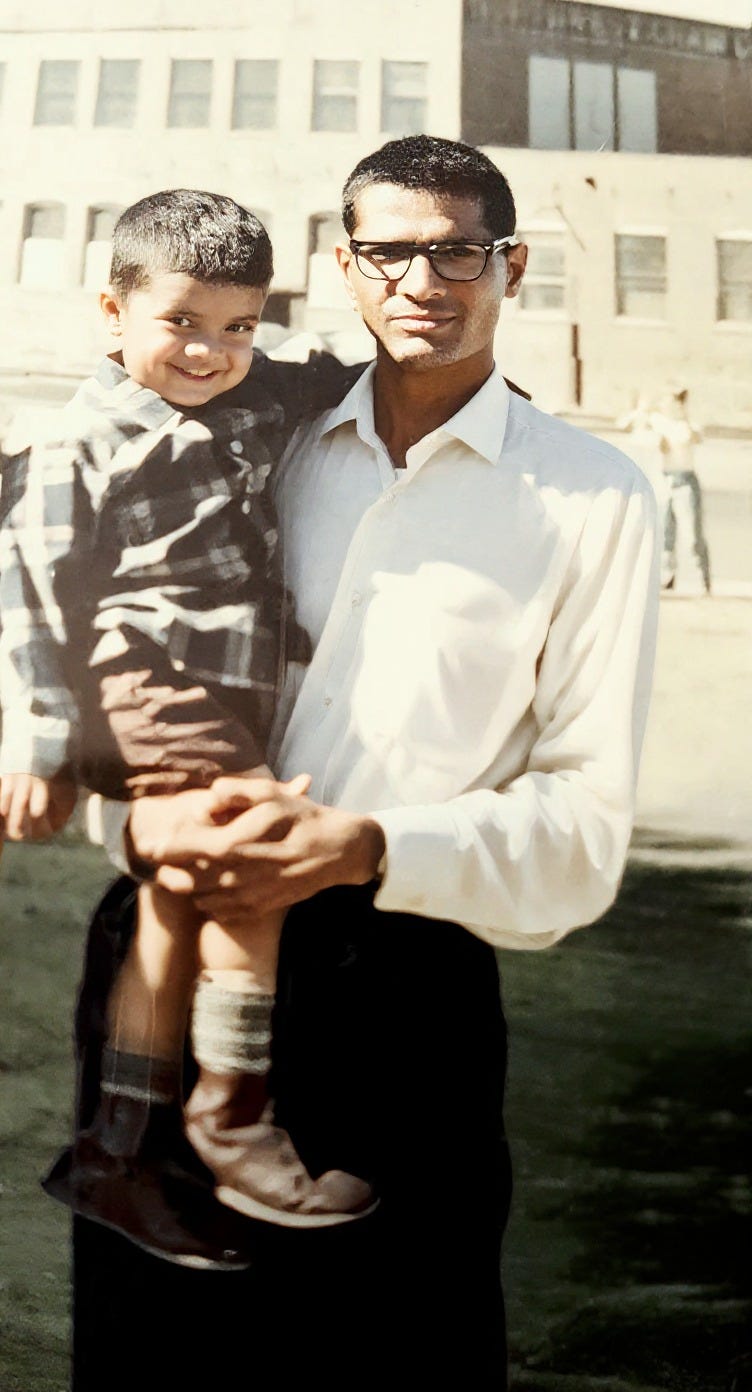
When we landed in Newark, I took my parents to my suburban home instead of their New York City apartment. I hoped that they might recover from their jetlag in a more relaxed setting. For my father, I knew he enjoyed the landscape of my home surrounded with families with children, the color green and the sound and smell of the Long Island Sound nearby. For him, the shape and texture and even the time and space of the world mattered. “Come here,” he would say, as he would show me something I had seen countless times in my home, and I would look at it through his eyes for the very first time.
“Abu,” I said, “Let’s go for a walk.” Though my father’s mind had faded, when we walked together, it was his intellect which propagated and directed our conversation. He would talk about phonological origins of various languages, discuss Islamic history and civilization and question the validity of a math theorem. His language was always measured, each word he chose to speak always had a definitive purpose. His most annoying and endearing trait was the manner in which he repeated himself. Sometimes it was for emphasis, sometimes it was a way for him to gather his thoughts, and sometimes the act of repeating himself became a metaphor for the mind and memory he was losing. However, his long term memory remained largely intact, and it was this history which I always tried to mine in the hopes that through understanding my father’s past, I might appreciate better some of the events which weighed on the course of my family’s history. Yet, piecing that history together was like being on a sailboat, my father’s memories were the rudder, yet without a commensurate wind of context, a rudder without wind simply meant that it was impossible to point, let alone move in any one direction.
As we walked, I could see that he was happy, so I asked him if he wanted to continue our walk into our community’s small downtown and get some ice cream. He delighted in the idea. We sat in front of the ice cream store each with a cone of Mango ice cream, my father’s favorite. “Abu,” I asked him, “Do you remember when you took me to your village in India and showed me where you planned to plant your mango orchard?” He said he did remember, but not the detailed memory I shared with him of my father showing me the graves of my grandparents, his description of the mango tree leaf, bloom and harvest and the tremendous heat which overpowered me. Most of all, I remembered him picking up the soil from the fields of his village with his hands and telling me how this dirt brought him tremendous despair and impecuniousness, yet how it was also the foundation of everything he would become.
A day later, I took my parents back to their apartment. The day after that my brother called to tell me that we had to take my father to the emergency room. We learned that he had an acute gallbladder infection, which had been built up over time but was probably triggered through the digestion of some fatty food.
When my father died six months later following a maze of circuitous events, I was the second after my brother to take a shovel and place dirt on his grave. As I picked up the dirt which would cover the remains of my father’s body, I tried to measure in my mind the improbability of my father’s life. His horizons were measured in miles while mine were in inches. Perhaps I might find the wind to set sail, and my rudder might still be the memories of my father’s life, but I longed for the repetition of my father to direct me along the way.
❤️